






In a first, training for the formation of Village Health Councils (VHCs) began in Meghalaya, with East Khasi Hills block officials the first to be trained.
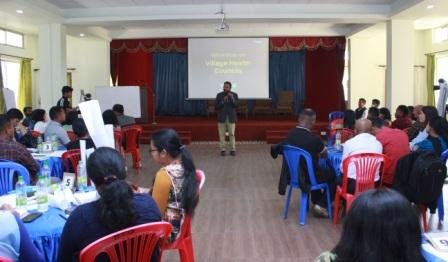
A two-day VHC training was held from March 14 to 15 at MIIT, Shillong. These training programmes are being conducted by the Department of Health and Family Welfare supported by the National Health Mission in collaboration with Social Welfare and Community and Rural Development Departments.
The first day of the workshop focused on building VHCs as strong community institutions for initiating community action on health and nutrition, purpose and membership, structure of VHCs as well as group discussions and idea sharing exercises by the participants.
The second day focused on the collaborative approach of sector teams at the block level and their importance in building VHCs and in solving local health and nutrition challenges.
Important success stories and positive outcomes of the sector meetings in improving institutional delivery as well as saving the lives of mothers and infants were also shared with the participants. Sessions on making action plans as per priorities as well as diligently following them up was also given to the trainees. Following this programme, the trainees will, in the next few weeks, make a plan for the VHC formation process in their respective blocks.
The state cabinet on January 19 approved the formation of VHCs. The establishment of such councils in every village and urban locality in the state is envisaged as a key means of improving community engagement in the healthcare system in order to achieve the goals of the state’s Health Policy, which was approved and passed in 2021.
Addressing the first batch of the VHC trainees, Mission Director of NHM Meghalaya, Ram Kumar, informed that training of this calibre was held 15-16 years ago for the formation of Village Employment Councils (VECs) across Meghalaya. VECs have since then played an instrumental role in the rural employment guarantee scheme (MGNREGS) uptake.
Similarly, VHCs are envisioned to bring about a revolutionary change in not only the uptake of public health service by communities but also achieve the objective of increasing life expectancy, which, in Meghalaya, is lower than the national average.
He reiterated that communities in Meghalaya played a significant role in mitigating the effects of the Covid-19 pandemic through the Community Covid Management Committees (CCMTs). The VHCs will formalize the role of communities in addressing health issues, while also strengthening the state to manage future pandemics or health eventualities.
Addressing the participants, Principal Health Secretary Sampath Kumar stated that VHCs will help to generate demand for the health services, in tandem with the government’s efforts to also address supply side challenges. The idea is to bring a sense of ownership among the people about solving problems that are often left unidentified or unaddressed.
Highlighting the collaborative approach of the VHCs, the CEO of Meghalaya State Rural Livelihood Society (MSRLS), Ramakrishna Chitturi, stated that health, nutrition and poverty are all interrelated and not isolated issues. Poor health and nutrition is a direct impact of generations of unaddressed poverty and economic disempowerment.
Director of Social Welfare Dikki D Shira also addressed the first batch of the VHC trainees in Shillong and motivated them to take the cause further down to the village level.
Extensive VHC training of officials will be seen in the coming few weeks in West Jaintia Hills, East Jaintia Hills, Ri-Bhoi, South West Khasi Hills and Eastern West Khasi Hills districts.
This will be followed by training to be held in West Garo Hills, South West Garo Hills and South Garo Hills.