










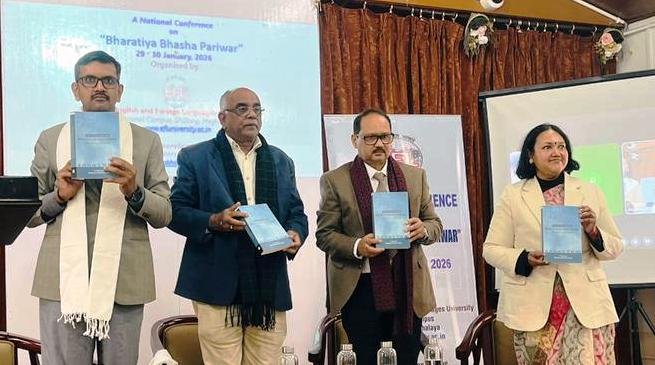
Shillong, Jan 31: A two-day conference on Bharatiya Bhasha Pariwar was jointly organised by the English and Foreign Languages University (EFLU), Regional Campus, Shillong, and the Bharatiya Bhasha Samiti, Ministry of Education from January 29-30, at the campus premises.
Vice Chancellor of the Gauhati University Prof. Nani Gopal Mahanta highlighted that every language embodies a unique worldview, a historical lineage, and a unique knowledge. He noted that the Northeast, with nearly 300 ethnicities and languages, offers a fertile ground for social and anthropological research. Unity in diversity, he remarked, does not imply homogeneity but a shared civilizational framework. He cautioned that efforts at documentation have often focused on difference and marginality, overlooking the region’s role as a cultural corridor to South and East Asia.
He also underscored the critical role of technology in preserving endangered languages with dwindling speaker populations, while warning against machine-driven processes that may inadvertently erase linguistic nuances.
Chairman of the Bharatiya Bhasha Samiti Padma Shri Chamu Krishna Shastry in his address emphasised that, although India has 1,369 languages, as per the 2011 census, and these languages are classified in various ways, such classifications should not be used for political division, but rather as a source of unity.
Meghalaya Chief Electoral Officer BDR Tiwari emphasised that languages and cultures exist in an interrelated continuum. While Sanskrit is the oldest written language, the Northeast is home to numerous languages and ethnic communities, each possessing sacred significance beyond religious usage. He observed that divisions often weaken community bonds and stressed the role of language as a key instrument of socialisation. Calling for a departure from colonial modes of thought, he urged the adoption of indigenous perspectives on India’s knowledge systems and cultural heritage.
EFLU Vice Chancellor Prof. N. Nagaraju reaffirmed the university’s commitment to advancing language research. While all languages are constitutionally recognized, he cautioned that languages cannot survive without safeguarding the communities that speak them.
Two books, Bharatiya Bhasha Pariwar: A New Framework in Linguistics and Collected Studies on Bharatiya Bhasha Pariwar: Perspectives and Horizons were also launched during the inaugural session.
The conference also featured research papers and thematic talks by prominent scholars on multilingualism, oral and traditional practices, use of technology and AI tools, and several topics related to preservation and conservation of linguistic and ethnic diversities.