






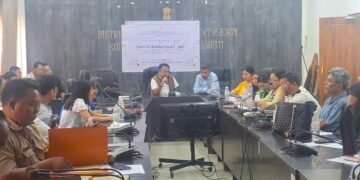





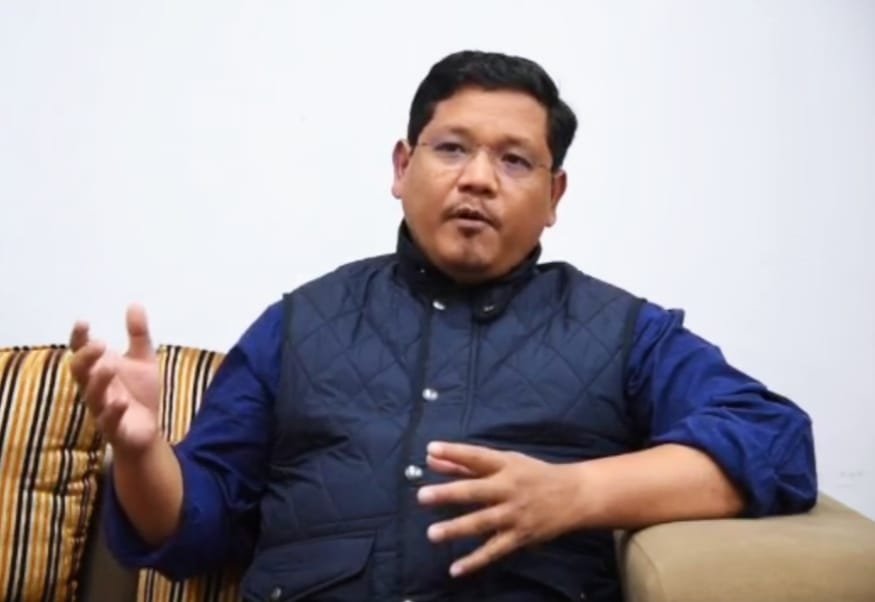
Meghalaya Chief Minister Conrad K Sangma and his Assam counterpart Himanta Biswa Sarma will meet Union Home Minister Amit Shah in New Delhi tomorrow evening to submit the proposals of the two states to resolve the boundary dispute in six border areas.
“The Assam Chief Minister and I will submit the reports to the Union Home Minister in Delhi tomorrow evening. We will be submitting more or less a common report. The Government of India will then move according to the laws,” Sangma told media persons here today.
Sangma also said that the recommendations of the regional committees of Meghalaya and those of Assam will be given to the Union Ministry of Home Affairs for further action
He also said that after discussions with Shah, the Ministry of Home Affairs will finalise an agreement to settle the border dispute in the six areas namely Hahim, Gizang, Tarabari, Boklapara, Khanapara-Pillingkata and Ratacherra.
These six areas fall under Kamrup, Kamrup Metropolitan and Cachar districts of Assam and West Khasi Hills, Ri-Bhoi and East Jaintia Hills districts of Meghalaya.
Sangma said that the structure for boundary settlement in six areas of differences has almost been reached after a long-drawn exercise between the two states.
There are 36 villages in the six places, covering an area of 36.79 sq km.
He also said that the boundary demarcation will be done after the due procedure in Parliament.
“The Survey of India will have to come in and joint inspections may have to be done and the Bill has to be passed,” Sangma said.
According to Sangma, the two states have agreed on the villages in the border areas, and identified natural boundaries such as rivers and forests.
Refusing to share details of the report, Sangma said that once a common agreement is reached in the presence of the Union Home Minister “that will be the appropriate time for us to declare and share the details of this (report)”.
He however hinted that apart from historical facts, the sentiment of people residing in the border areas and ethnicity was kept in mind.
“Therefore, the willingness of the people in specific areas has been one of the main driving forces or the principles on which we have reached most of the conclusion in most of the areas,” he said.
“We have also considered ethnicity as something very important. Both the Assam and the Meghalaya governments have felt strongly that any of the states may try to claim an area but if the people living in that area don’t wish to be in a particular state, one cannot force them,” he added.
Stating that the boundary dispute has been going on for 50 years, and resolving it was a difficult task, Sangma said that due to the efforts made by the two states, a solution has been arrived at.
“We consulted multiple stakeholders, have had multiple meetings and multiple visits. As I said, this is truly a very important and historic moment,” he said.
Meanwhile, the disputes in six other remaining areas, which are termed as “complicated,” will be taken up for settlement in the next phase.