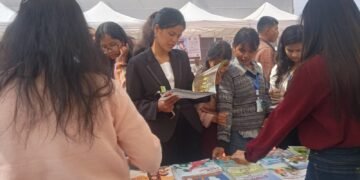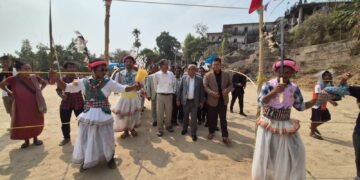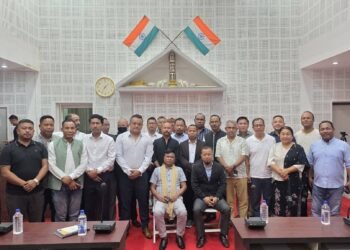










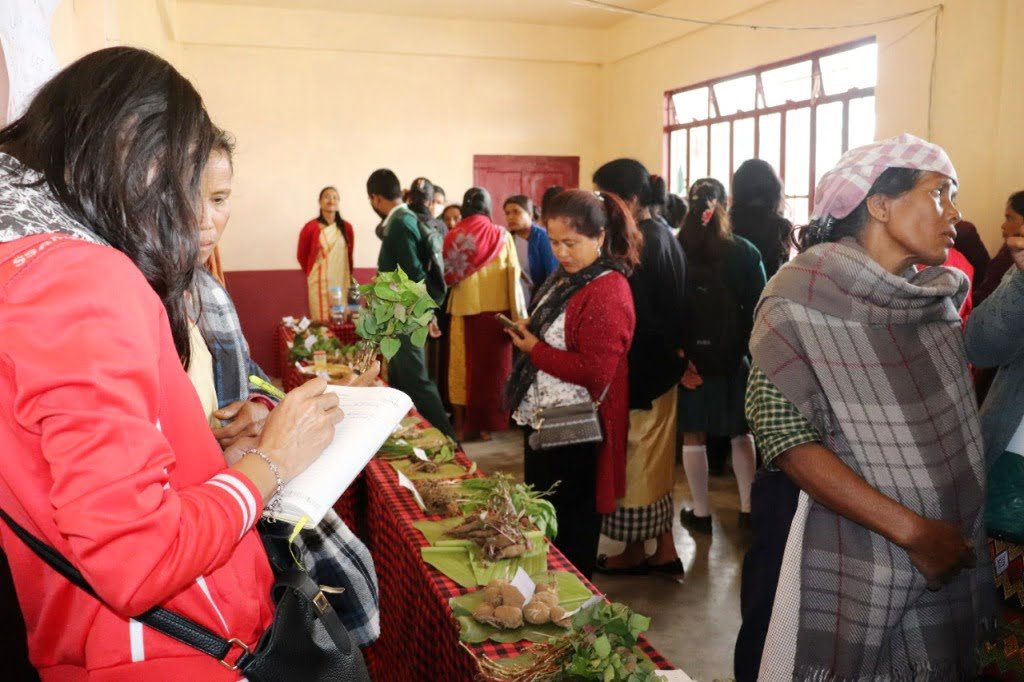
Farmers under the Agroecolgy Learning Circle (ALC) from various parts of West Jaiñtia Hills district today participated in a community seed fair exchange visit at Sohmynting village.
The programme was organised by SURE in collaboration with NESFAS wherein about 56 varieties of seeds were brought by farmers from Sohmynting, 55 from the Community Seed Bank at Mulum, ALC of Lumtrep brought in 18 varieties and ALC Larnai with 11 and Ksehrynchang 12.
Dr. H.H Mohrmen, Chairperson, NESFAS lauded the local farmers for having practised organic farming for so long and encouraged them to continue doing so, stating that the most important goal of the project is to revive and sustain traditional farming. Further, he added that an essential aim of the ALCs is to contribute to the local economy and livelihood: “We have to make it our mission for young people to start adopting traditional farming to support themselves. We have practised traditional farming in our region for a long time and it is not something that needs to be taught to us. It is our strength and we don’t have to rely on others for jobs if we pick up traditional farming.” Mohrmen said.
A short session on knowledge exchange was also held wherein ALC members shared their traditional knowledge and stories. Roomika Pyrtuh, an ALC member from Sohmynting narrated the gripping origins of the humble sohphlang (Flemingia Root) which is now an important crop in their village.
According to her story, the crop was first introduced to the village when a man from Smit region married a woman from Sohmynting. The man brought two seeds of sohphlang along with him and over the years the two seeds have multiplied in multitudes. Today, sohphlangis one of the biggest sources of income for most of the families in the village, she said.
Ebormi Lyngshiang, Officer, Disaster Management Department, speaking to the community members pointed out the worrying trend of how many indigenous seed varieties have disappeared over the years. He lauded the effort of NESFAS and SURE for taking the lead in defending the Indigenous Food Systems and sensitising the communities on how to preserve the rich diversity of indigenous seeds these communities have.
The community members also shared their appreciation towards NESFAS and SURE for the role they have played in helping them defend and revive their traditional methods of farming.
Kitboklang Suchiang, an ALC member from Mulum who manages the community seed bank in her village shared how the community seed bank established in 2019 with the help of SURE and NESFAS has helped the community revive traditional farming with the use of indigenous seeds and varieties.“I ensure that we only preserve and keep indigenous seeds and refrain from storing or even accepting HYV seeds which are distributed for free by various external institutions or organisations.”
Participants also went for an ABD walk in some of the food production systems in the community; the kitchen garden and nearby forest. The school children who did their ABD walk in the kitchen garden of Mero Lyngdoh Pyrtuh identified 44 food plants, including fruit trees with her help. Another 21 food plants were also identified in a nearby forest.
Community Seed Systems ensure the local seed requirements of farmers and are strengthened by seed exchanges among farmers and communities and also exchange of knowledge associated with it. However, over the years, the growing focus on mono-cropping, declining interest in agriculture, the introduction of high yielding, and other factors are contributing to the gradual decline in traditional seed varieties.