











By Budwanmi P Dkhar
The Chadsukra festival is a significant cultural celebration of the people of the Jaintia Hills, with the main event held in Jowai. It is deeply rooted in the indigenous faith of Niamtre and reflects both spiritual devotion and community unity. Traditionally known as a sowing festival, Chadsukra is not merely a cultural event but also carries profound meanings that remain highly relevant in the modern academic and contemporary world.
Before the main day, each locality and Seinraij actively prepares for the celebration through songs, dances, and cultural performances. A notable feature of this preparation is the theatre performance held prior to the festival. These performances often depict stories that send moral and cultural messages—some highlight kingship, family values, or community life, while others may focus on love stories. Regardless of the theme, the theatre performances always carry a deeper lesson, reinforcing traditions and providing insights into societal values while building anticipation for the main festival.
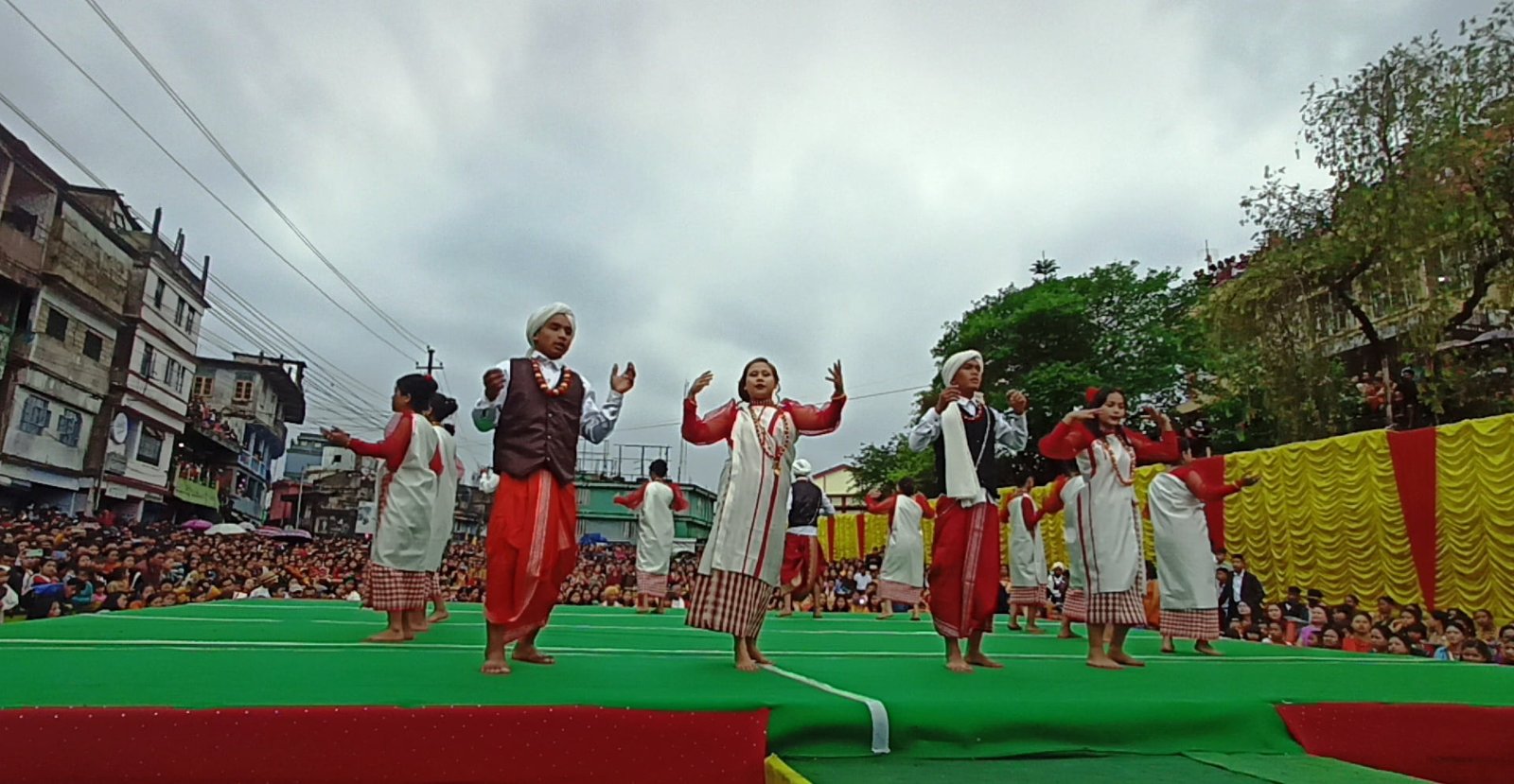
On the main day, the festival takes place at the Iawmusiang Market, a traditional marketplace of the Jaintia people. The festival is also referred to as “Chad Mih Iaw,” meaning “we move or dance to Iawmusiang.” This vibrant procession is more than a festive display—it sends a symbolic message that Jowai is ready for the harvest, connecting the entire town to the agricultural cycle. The dance procession, vibrant with traditional attire and energetic performances, captures the essence of the festival. Chadsukra means dance with a joyful heart, reflecting the spirit of unity, gratitude, and celebration among the people.
At its core, Chadsukra is a prayer for a good harvest and a way to express gratitude and respect towards nature. The environment is revered as Bei Rymaw, while prayers are offered to the Almighty U Trekirot. Through rituals and ceremonies, the people acknowledge their dependence on nature and seek blessings for prosperity and well-being. This spiritual connection highlights a worldview where humans are not separate from nature but are an integral part of it.
In modern times, the idea of “harvest” can also be interpreted in a broader and more contemporary sense. In the academic world, harvest may symbolize intellectual growth, knowledge, and the success of education. Just as earlier generations prayed for a successful crop yield, today’s generation can view Chadsukra as a symbol of hope for a successful “harvest” of educated individuals—encouraging more people to gain knowledge, achieve academic excellence, and contribute meaningfully to society. In this way, the festival bridges the gap between tradition and modern learning.
One of the most important messages of Chadsukra lies in its emphasis on environmental protection. The teachings of Niamtre have long promoted respect for nature, making environmental conservation not just a practice but a moral and spiritual responsibility. Long before modern environmental movements, indigenous communities in the Jaintia Hills had already developed sustainable ways of living. A powerful example of this is the preservation of sacred groves—forest areas protected due to their religious and cultural significance. In these groves, cutting trees or harming any living being is strictly forbidden, allowing them to serve as natural reservoirs of biodiversity and ecological balance.
This indigenous approach to conservation is now being recognized by modern academic disciplines such as environmental studies and ecology. Scientists and researchers increasingly acknowledge that traditional knowledge systems offer valuable insights into sustainable living. The practices followed by the Niamtre community demonstrate that environmental protection is not a new concept but an ancient wisdom that has been passed down through generations.
In contrast, modern human activities have caused significant damage to the environment. According to the Intergovernmental Panel on Climate Change (IPCC), human activities have already led to approximately 1.1°C of global warming above pre-industrial levels. The Food and Agriculture Organization (FAO) reports that around 10 million hectares of forest are lost every year due to deforestation, largely driven by agriculture, urbanization, and industrial expansion. Furthermore, the World Health Organization (WHO) highlights that pollution contributes to millions of premature deaths annually, affecting both human health and the natural environment. These statistics clearly show how human activities—such as deforestation, industrialization, and pollution—are seriously damaging the environment.
In this context, the message of Niamtre becomes even more relevant. Through festivals like Chadsukra, it teaches that protecting nature is not just a scientific responsibility but also a moral and spiritual duty. The respect shown to Bei Rymaw and the conservation of sacred groves demonstrate that this message has already been passed down through generations.
Chadsukra also plays a vital role in strengthening social unity and cultural identity. In a rapidly globalizing world, where traditional practices are often at risk of being forgotten, festivals like this serve as a reminder of cultural roots and heritage. They create a sense of belonging and continuity, ensuring that future generations remain connected to their traditions. From a sociological perspective, Chadsukra functions as a social institution that reinforces community bonds, collective identity, and shared responsibility toward nature.
Moreover, the festival encourages a balanced approach to development. While modern education and progress are important, they should not come at the cost of environmental degradation or cultural loss. Chadsukra teaches that development and sustainability must go hand in hand. It calls for a future where knowledge and tradition coexist, where scientific advancement is guided by ethical responsibility, and where cultural heritage is preserved alongside modernization.
In conclusion, the Chadsukra festival is far more than a traditional sowing celebration. It is a powerful indigenous voice that speaks to both the past and the present. It promotes environmental awareness, encourages academic growth, strengthens social unity, and highlights the importance of preserving cultural heritage. Most importantly, it delivers a timeless message from the teachings of Niamtre—that humans must live in harmony with nature. At a time when the world is struggling with ecological challenges, this message is not only relevant but essential. By understanding and embracing the values reflected in Chadsukra, communities can work toward a more sustainable, responsible, and enlightened future.