







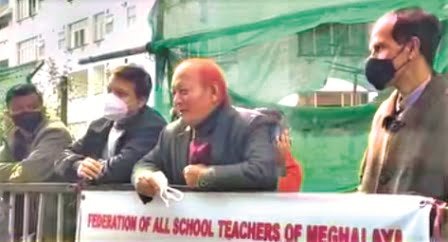
Ad hoc school teachers under the banner of the Federation of All School Teachers of Meghalaya (FASTOM) today staged a protest in front of the Secretariat to put pressure on the state government to give in to their demands.
FASTOM is demanding that all ad hoc schools be upgraded to the deficit system or at least deficit patterns.
Speaking to Highland Post, president of FASTOM, Kenneth Shadap, said that the teachers will continue their protest until January 20 and will follow it up with a black flag protest the next day, which will be Meghalaya’s 50th anniversary of statehood, if the government does not invite them for talks and provide a written assurance to their demands.
There are, according to FASTOM, 1,860 ad hoc schools in Meghalaya and a total of 7,090 teachers in them. It would take an additional Rs 250 crore per year to bring them up to the deficit level.
It is this added cost that is the problem for the government, according to Education Minister Lahkmen Rymbui.
“The state government is alive on the issue but it is not easy for the government to do it now,” he told reporters today. “The process is on but I cannot promise whether it will be done as per the teachers’ wishes.”
Shadap said that the Chief Minister, Conrad Sangma, had given a verbal assurance in 2019 on their demands and held talks with the teachers last September where it was promised that the ad hoc schools would be upgraded to the deficit pattern at least.
Ad hoc teachers get substantially lower pay than their deficit system counterparts. A lower primary teacher in the former category, for example, receives Rs 12,000 per month in salary compared to Rs 45,000 (according to Shadap) in the latter category, which is “pure injustice”.
Instead of the array of categories there should really be only three, he opined, namely government school, government-aided and private.
“I urge the government to call us for dialogue and stop giving us this step-motherly treatment because we are nation builders and everyone is equal in the eyes of the law. The government cannot ignore us and violate our fundamental rights,” Shadap added.