




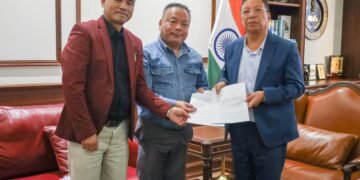








Union Minister of State for Cooperation, Krishan Pal Gurjar, concluded his two-day official visit to Meghalaya today as part of the Centre’s ongoing efforts to assess and accelerate developmental initiatives in the North East.
The minister engaged with senior state officials, district administrators and departments to review the implementation of centrally-sponsored schemes, with a strong emphasis on infrastructure, social empowerment and livelihood-based programmes, an official press release stated.
Gurjar also addressed the media, acknowledging the challenges in land acquisition due to hilly terrain, forest cover and community ownership for critical infrastructure projects like airports and railways in Meghalaya. He said, “In a democracy, we must listen to people’s concerns. Environmental sensitivity and local participation must go hand-in-hand with development.”
He called for transforming Khasi Hills into a model of development, stating, “Let it be an example of what a truly developed India can look like. I am truly pleased to see the honest and dedicated efforts made by the administration here in Khasi Hills. It is visible on the ground, and I congratulate everyone involved.”
“The government of India’s vision for a Viksit Bharat can only be achieved when every region, including remote and hilly areas like Meghalaya, progresses hand-in-hand with the rest of the country,” Gurjar said.
He emphasised the importance of effective Centre-State coordination, digital monitoring and efficient fund utilisation, while calling for the timely and transparent execution of projects.
Gurjar reviewed the progress of flagship schemes such as the Pradhan Mantri Awas Yojana (PMAY), the Lakhpati Didi initiative, Jal Jeevan Mission and the strengthening of Primary Agricultural Credit Societies (PACS) among other centrally sponsored schemes. He acknowledged the successful implementation of these programmes, noting that grassroots feedback is crucial for policy evaluation and real-time course correction.
During his address he mentioned the establishment of Tribhuvan Sahkari University (TSU) earlier this month stating that it is the first university in India dedicated to cooperative education and will produce professionals who will lead the cooperative movement across the country.
He added that the Ministry of Cooperation has set a target to create 2 lakh new multipurpose PACS within two years, encouraging economic self-reliance through community-driven models. Earlier, PACS were largely limited to credit and loan functions, but have now been transformed into multipurpose institutions supporting agriculture, dairy, fisheries and rural enterprise.