








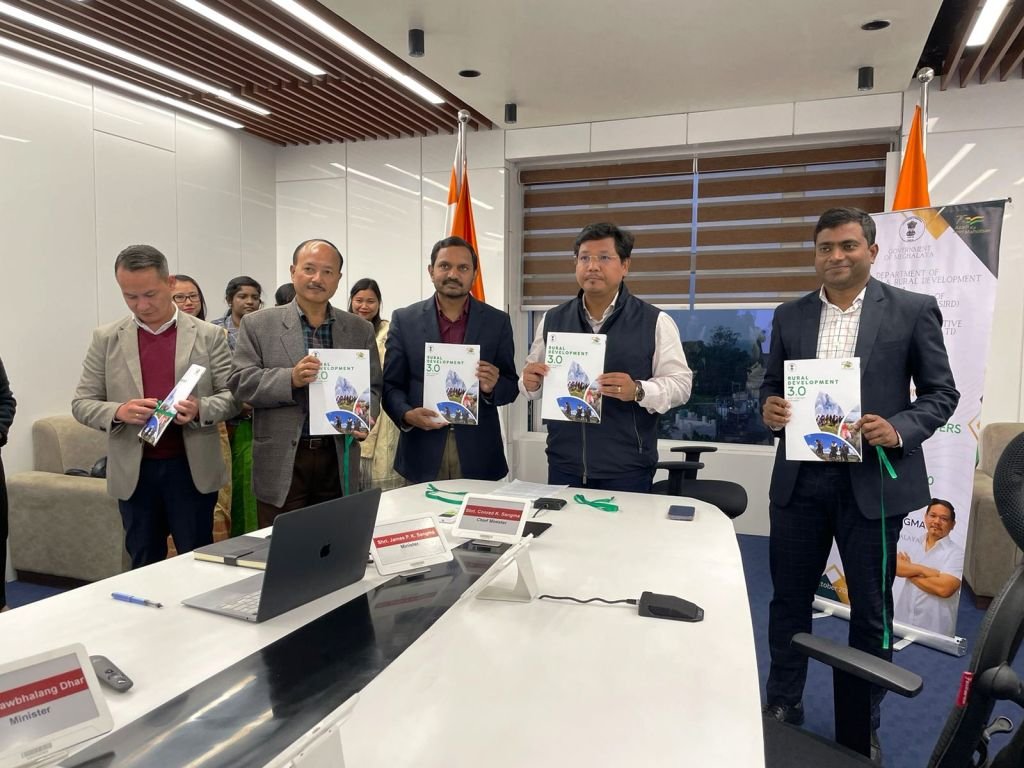
Chief Minister Conrad Sangma on Friday launched the Rural Development 3.0 Vision Document during the valedictory function of the two-week long training programme of the Junior Rural Development Officers (JRDOs) whose orientation programme concluded here yesterday.
According to a statement, the Rural Development 3.0 Vision Document has been initiated with an “objective to go beyond the existing initiatives under Rural Development 2.0 and extend the efforts in shaping the state’s rural economy to be self-sufficient, resilient and future-oriented.”
Speaking at the occasion the Chief Minister deemed this development as a massive revolution that will enhance collaboration and inter-departmental convergence in the interest of community and rural development.
Emphasizing on the role of the newly recruited JRDOs who completed phase 1 of their training, he said that this is an important step taken by the state to set up a dedicated cadre to cater to several rural needs of the State. He added that reinvigorating rural development in different villages across the state can generate off-farm income opportunities, reduce vulnerability, and narrow the urban-rural income disparity.
Community & Rural Development principal secretary Sampath Kumar said that the vision document lays out significant goals across 4 core dimensions- economy, human development, environment and local governance. He said that the government is addressing systemic challenges to rural development by adopting a holistic approach that focuses not only on upscaling uptake of existing schemes such as MGNREGA and NRLM, but more so, by creating an enabling environment by strengthening communities, especially the women’s collectives, that would ensure sustainability of developmental activities.
It may be noted that Meghalaya is using the principles of State Capability Enhancement Project (SCEP) to operationalize the vision of RD 3.0. A key guiding principle of SCEP is facilitating collaborative and local problem-solving, and, in the process, building systems that are more responsive to development needs and can support a long-term, sustained transformation of the state.