












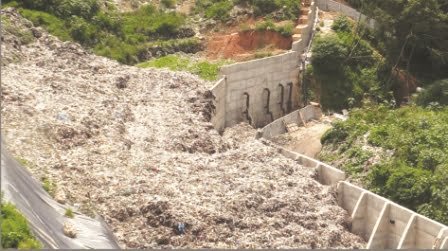
The Meghalaya High Court has said that Marten landfill site at Mawlai here should be closed if it has reached the saturation point and after finding an alternative site.
In an order passed today, the division bench of Chief Justice Sanjib Banerjee and Justice Wanlura Diengdoh said, “Appropriate steps should be taken to close the landfill site at Marten, if it has reached the saturation point, upon any alternative site being identified for immediate use.”
The court also said that long-term measures through the involvement of local authorities need to be taken along with immediate steps, particularly in the light of the increasing footfall of tourists in the State.
“General “dos” and “don’ts” have to be indicated, levels or distances beyond which tourists may not be permitted should be earmarked, a safe distance be maintained between the edge of the water-bodies and vehicular traffic, including parking; and the restriction of certain material like plastics and tetra packs should be indicated. If it appeals to the State, plastics and tetra pack-free zones around the water-bodies should be demarcated, maintained and tourists and local residents be required to adhere thereto,” the High Court said.
As suggested by senior lawyer S P Mahanta who is the Amicus Curiae in the matter, the High Court directed that at major tourist spots, sign boards should be put up to indicate the “dos” and “don’ts”, with local personnel engaged to ensure adherence and help-lines should be given for any complaints.
“It is best that the locals be involved in the process as that would result in a personal touch and the affinity to protect and preserve the immediate environment. The State may consider some form of honorarium or reward for the personnel engaged for such purpose,” the court said.
The High Court also stated that several of the rivers, particularly those passing through Shillong city or the larger towns like Nongstoin, require to be rejuvenated and the natural system of flow should be restored with scientific advice.
“While citizens along the rivers must have access to the water, there should be awareness campaigns to indicate the nature of permissible use and what other activities would not be permitted.
In particular, the measures should be geared to preserve, protect and rejuvenate plants and animals that live or thrive in water,” the court said.
Stating that both long-term and short-term measures have to be devised and sincerely implemented, the High Court asked the State authorities to issue appropriate guidelines first to arrest the further degradation of the water-bodies, then to preserve the same and ultimately to rejuvenate or revive them.