







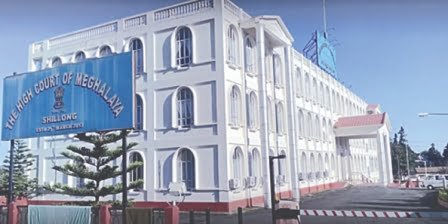
The Meghalaya government has been pulled up by the High Court today over an amendment brought about by the government in the Meghalaya Minor Minerals Concession Rules, 2016 on January 29, 2018. The court said that the amendment appears to be a “disingenuous design to facilitate illegal quarrying and mining”.
In the amendment, a new definition was added to the Rules of 2016 by introducing, inter alia, clause (u) to define “incidental”. The amendment said, “Incidental in the context of extraction of minor minerals means such an unintended extraction which arises out of non-mining activities such as construction of roads or other major infrastructural projects.”
While taking up a public interest litigation today, the division bench of Chief Justice Sanjib Banerjee and Justice Wanlura Diengdoh said, “The abode of clouds appears to be an abode of anarchy: and, quite alarmingly, it may be State sponsored.”
Stating that “incidental extraction” of minor minerals may be misused by any person, the High Court directed the State Chief Secretary to file a report on the immediate measures taken to check such “incidental” loot of minor minerals when the matter comes up for hearing again on April 25.
“As is evident, the definition is not exhaustive and it refers to certain activities like construction of roads and other major infrastructural projects as falling within the meaning of ‘incidental extraction’ of minor minerals, but deliberately leaving it open for interpretation and application in other cases. Thus, a person may dig deep in his ground to extract some minor mineral and claim to have ‘incidentally’ extracted the same while preparing the field for cultivation. And, as an official list shows, that is exactly what has happened by acts of wanton plundering by euphemistically referring to it as ‘incidental’ extraction and the administration endorsing such activity,” the High Court said.
“What is more distressing is that even though such ‘incidental’ extraction of minor minerals was officially recognised, the transportation of such “incidentally” extracted mineral was not provided for since Rule 26 of the said Rules of 2016 was confined to transportation by only lessees or permit-holders and persons who “incidentally” extracted minor minerals could not be said to be either lessees or permit-holders. Nonetheless, from the date of the notification of January 29, 2018 “incidental challans” came to be issued for transportation of minor minerals that had been “incidentally” extracted in terms of the definition of “incidental” introduced as Rule 2(u) of the said Rules of 2016,” the High Court added.
Even Advocate-General Amit Kumar who appeared for the State government at the hearing has no answer to any of the glaring anomalies that have been pointed out. He admitted to a sorry state of affairs in the government.
In the meantime, the PIL revealed that several persons “incidentally” extracted amounts as much as 99,061.2 MT, 42,907 MT, 34,621 cubic metre of limestone in the course of construction of a farmhouse or a residential pathway or paving the way to a paddy field.
“There are several such instances of large scale ‘incidental’ extraction of limestone without it being in the course of any road construction or infrastructural project. There is no doubt that there is executive complicity in the matter. Indeed, this reflects an utterly inept bureaucracy and no check or balance or any accountability at any level,” the High Court said.
The court also said that it was apparent that there was State support for the continuing illegal mining despite orders having been passed several years back by the Supreme Court and the National Green Tribunal (NGT).
“Indeed, one of the persons who ‘incidentally’ extracted limestone as a minor mineral was involved in coal-mining operations prior to the NGT ban as has been disclosed in a list issued by the Divisional Forest Officer of Jaintia Hills Territorial Division, Jowai, a region which has seen rampant illegal coal mining that prompted suo motu proceedings to be initiated by this court,” the division bench said.
Stating that it may be necessary for external agencies, not having any connection with the State, to be brought in to put the house in order here, the High Court said, “It is inconceivable that such colossal maladministration caused by design would continue despite there being a bureaucratic set-up in place. At best, the administration appears to be rudderless with the deficiencies admitted by learned Advocate-General everyday but no remedial measures being taken.”
The High Court also questioned the Forest Department which is entrusted with the matter of monitoring licenses and permits under the said Rules of 2016 without there being any separate specialised authority in such regard.
It also said that tens of crores of rupees in revenue have been lost at least from 2018 to 2021 from illegal extraction of minor minerals by tweaking the definition provision and including “incidental” within its fold without following it up by maintaining any check or balance as to how the “incidentally” extracted limestone or minor mineral was being transported or dealt with.
“It obviously led to free loot and a mad scramble among the most favoured to make merry at the cost of the State. The guardians of the State assets let veritable poachers in for obvious extraneous considerations. The State’s action is not unakin to a house owner inviting thieves to loot all his properties and then seeking a commission on the sale thereof,” the High Court said.