
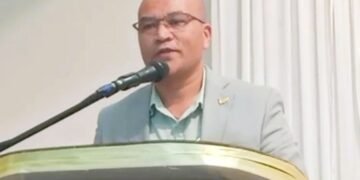






Meghalaya PHE Minister Renikton Lyngdoh Tongkhar will attend the North East Regional Conference of Ministers of the Public Health Engineering Department tomorrow at Guwahati, Assam.
Union Minister of Jal Shakti, Gajendra Singh Shekhawat will chair the regional conference which will focus on important issues pertaining to implementation of Jal Jeevan Mission (JJM) and Swachh Bharat Mission (Grameen).
The Union Minister will be setting the roadmap for the North East states, keeping in line with the guidance received from the Prime Minister, Shri Narendra Modi, during the webinar on ‘Post Union Budget 2022 – Leaving No Citizen Behind’ held on February 23.
Difficult terrain, heavy rain and snowfall coupled with erratic supply of construction material greatly impacts the progress of the JJM work in the border regions of the North East.
Reaffirming the commitment towards public health and well-being of the people living in rural areas, the Union Budget 2022-2023 fund allocation for JJM has been increased from Rs 45,000 crore in 2021-22 to Rs 60,000 crore in 2022-23.
For SBM (Grameen) Rs.7,192 crore have been allocated in the Budget 2022-2023.
JJM is a flagship programme of the Government of India being implemented in partnership with states and union territories, aims at providing tap water connection to every rural household in the country by 2024.
Meghalaya, Manipur and Sikkim aim to achieve tap water connection to every rural household by December 2022.
The deadline set by Arunachal Pradesh, Mizoram, Tripura and Nagaland is 2023. Assam aims to meet the goal in 2024.
SBM (G) is another flagship programme being implemented by the Ministry of Jal Shakti. All the states in the country achieved Open Defecation Free status by October 2, 2019, when villages across India had declared themselves ODF.
In its second phase, SBM (G) is focusing on ODF sustainability and to achieve solid and liquid waste management in all villages by 2024-2025 i.e., to transform the villages to ODF Plus.
Under SBM (G), North East states have done good work on sanitation. Achievement of ODF status has resulted in substantial health gains for people.
The resources under SBM (G) are being used to support construction of individual toilets for the new households and community sanitary complexes for households without the space for toilet construction and floating population; grey water management systems; solid waste management, including door-to-door collection of waste.