










Hailstorms are not uncommon to Meghalaya, a state world famous for its heavy rainfall and cold winters but the one that hit Shillong today was an outlier.
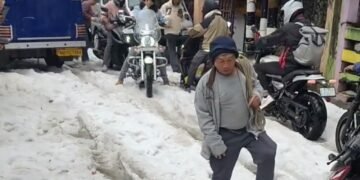
For between 30 minutes and an hour the city was blanketed with a continuous stream of ice cold pellets from the heavens that carpeted the city in ice. These were massive enough hailstones to damage cars or crops but they did cause quite a bit of chaos.
But Shillongites got off relatively easy. Farmers in Eastern West Khasi Hills over the weekend were not quite so lucky. They were hit by a much heavier storm, with bigger hailstones that flattened crops, including the all-important rice, just before the harvest. A few farmers from these villages said that, in previous such instances, they did not receive compensation for their lost crops but expressed hope that this time would be different.
Traffic was brought to a standstill in many places, with ordinary citizens, Home Guards and traffic police trying to clear roads with their bare hands or whatever improvised aid they could find. Shillong’s drainage is appalling and the city’s streets were overwhelmed with the rain and hail.
So, while Wednesday’s hail on Shillong made people compare it fondly to Kashmir and a winter wonderland, it was far from the case.
Although unusually heavy, it is a fact that the authorities were completely unprepared for such an eventuality. Ice on the roads is dangerous as vehicles lack grip. In other countries, authorities use grit or salt to melt snow and ice and improve traction for tyres.
Granted, days like this are once a year at most. But that is especially why the authorities need to prepare. Because if the storm could be this disruptive, it is conceivable that it could have been worse. And then what? Climate change is having real effects on Meghalaya – rainfall this monsoon was 60 percent below normal. This entire year was warmer than average but the likelihood of heavy cold snaps, hailstorms or worse should not be brushed off.
Another bizarre aspect of the hailstorm was the use of Artificial Intelligence to exaggerate the scale of the weather phenomenon.
Numerous images were shared on social media showing parts of the city blanketed in what appeared to be heavy snow. Some of these images even managed to fool journalists and at least one media house posted a couple of photos on Instagram before pulling them. It may have seemed like harmless fun to whoever produced those images but it is another demonstration of the potential for greater harm through falsified images and the ease at which such AI-generated nonsense can spread.