










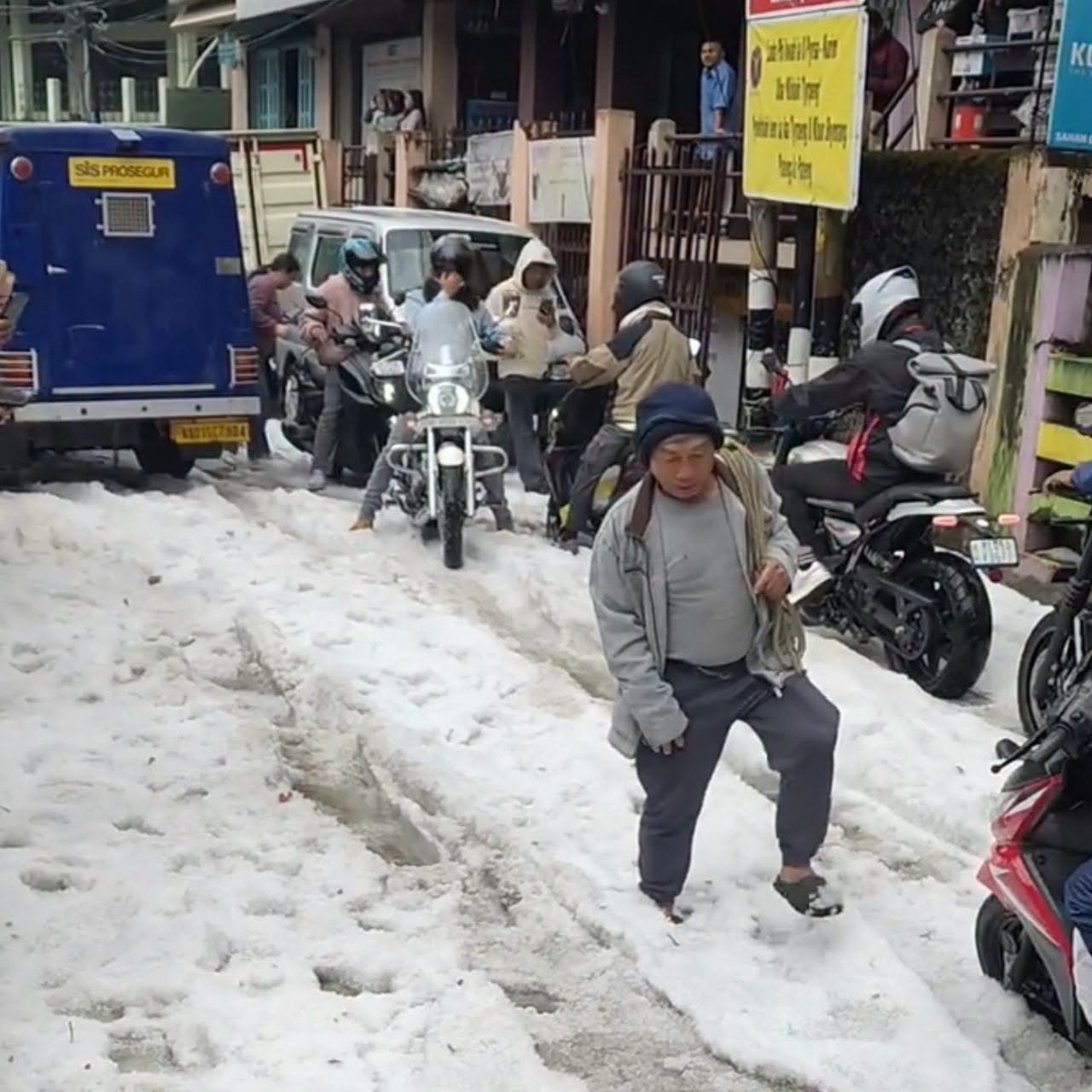
Shillong, Nov 11: A sustained hailstorm led to gridlocked traffic and choked and overflowing drains in Shillong today, though residents and tourists also found ways to enjoy the experience.
The hailstorm that hit Shillong on Wednesday morning was triggered by a convective weather system and was a short-lived event, the India Meteorological Department (IMD) has said, while warning of continued thunderstorms and rainfall in parts of Meghalaya until Thursday.
Meghalaya IMD Director Thangjalal Lhouvum said the department had issued advance warnings through its district weather bulletins and nowcast services. He said the state was likely to experience a dry spell after November 12.
The cold weather that accompanied the hail meant that roads were covered in ice for several hours. Videos and photos from certain places like Umsohsun showed ordinary citizens trying to make the roads passable for vehicles with their bare hands, while traffic police were also involved in clearing the way in Police Bazar. The authorities appeared to have been completely unprepared for such an eventuality.
Lhouvum said hailstorms during the post-monsoon and pre-monsoon seasons were not unusual in Meghalaya, as they could occur when atmospheric conditions were favourable, including under the influence of western disturbances and tropical jet streams.
With recent rainfall reportedly affecting crops in parts of the state, the IMD Director urged farmers and residents to regularly follow the department’s WhatsApp channel for weather updates and warnings.
He said the department had introduced block-level WhatsApp groups to ensure that forecasts reached farmers directly. It is also coordinating with state agencies, including the State Disaster Management Authority, to strengthen the dissemination of weather alerts.
Meghalaya has also started using the Common Alerting Protocol (CAP), which enables alerts to be sent directly to mobile phones during severe weather events.
On whether the state was witnessing a shift in its weather pattern, Lhouvum said the recent hailstorm and thunderstorms were part of normal post-monsoon weather activity. However, he acknowledged a declining trend in rainfall in recent years, although the long-term reduction was relatively insignificant when assessed against the state’s climatological record.
He said Meghalaya had received around 60 per cent less rainfall than its climatological normal this year. Citing rainfall data from Sohra, he said the area recorded approximately 4,380mm during last year’s monsoon against its normal of around 11,000mm, making it the lowest monsoon rainfall in the available long-term record.
For the upcoming winter season, the IMD has forecast below-normal rainfall and above-normal minimum temperatures across Meghalaya. Lhouvum, however, clarified that seasonal forecasts indicate broad categories of rainfall and temperature trends rather than providing precise predictions of how cold the winter would be.
Meanwhile, the department is working to expand its weather observation network across the state. Two existing part-time observatories are being upgraded into full-fledged IMD stations, while the Meteorological Office in Tura is expected to become fully operational early next year, preferably before the next monsoon season.
A meteorological office and exhibition centre are also planned for Mawsynram, with the project already receiving approval.
Meghalaya is also set to get two Doppler weather radars, one each in Shillong and Tura. According to Lhouvum, the radars will provide updated weather scans at intervals of approximately 10 minutes, allowing the department to track developing weather systems more effectively and improve short-term forecasting and warning services.
The IMD has also completed the development of its nowcast service in English, Khasi and Garo. The department expects the expanded monitoring infrastructure and improved dissemination of weather information to help farmers, residents and disaster management authorities prepare better for adverse weather conditions.