










Shillong, Nov 10: Citizens’ group Thma U Rangli-Juki (TUR) has sharply criticised Tourism Minister Paul Lyngdoh for enjoying a publicly funded jaunt to the United Kingdom rather than address the grievances of local women who have been protesting against the proposed Shillong Peak Ropeway project.
Lyngdoh and a large delegation of MLAs, civil servants and the Meghalaya Speaker are “galavanting” in the UK on a supposed educational trip.
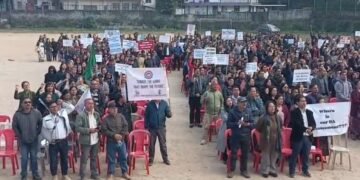
TUR, while once again extending support to the Joint Action Committee (JAC) against the ropeway said that it “views with concern the utter lack of responsibility shown by elected representatives, particularly the Tourism Minister in charge of the ropeway project. Rather than addressing the grievances being raised by women who have been staging a day and night protest for 5 days now, the minister in charge is galavanting in the UK as part of a contingent comprising 21 elected representatives and so many bureaucrats who are supposedly there on an educational trip.”
However, some good could come out of this overseas excursion, TUR said, if Lyngdoh and the others in government learn about the UK’s National Trust model that aims at ensuring conservation of architectural history, historic houses, castles, archaeological monuments, gardens, nature reserves, wildlife, landscapes and viewscapes.
“They ought to learn about and apply the National Trust’s concept of ‘inalienability’ – a powerful legal shield that permanently protects designated heritage lands from unsustainable commercial exploitation,” TUR said. “They ought to borrow from the Trust’s model of managing millions of visitors while maintaining pristine natural landscapes through strict statutory protections and deep community engagement. They should adopt the National Trust’s rigorous environmental benchmarks and community-consent frameworks to understand how genuine sustainable eco-tourism is supposed to function.”
Meghalaya’s public funds being used for such foreign trips should bring back concrete and actionable strategies on community-led preservation to ensure that any future state infrastructure respects both the fragile ecology and the indigenous sentiments of the state, the group added in a statement.