


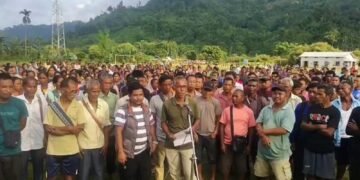
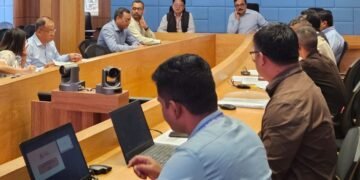




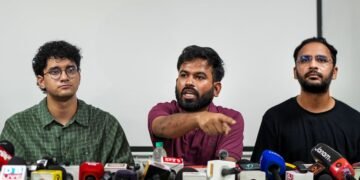




The political map of Meghalaya changed in a single afternoon in Delhi. Eight sitting MLAs of the United Democratic Party – the state’s oldest regional party – formally joined the Bharatiya Janata Party on Wednesday, raising the BJP’s strength from 2 to 10 in the 60-member Assembly.
On paper, it is a routine defection in a state accustomed to political musical chairs. In reality, it is the most significant consolidation of the BJP in Meghalaya since the party first entered government as part of the Meghalaya Democratic Alliance in 2018. For the first time, the BJP is the second largest party in the Assembly, ahead of its own regional allies.
The eight who switched are not fringe figures.
At the press conference, Cabinet Minister Lahkmen Rymbui listed four emotive issues: inclusion of Khasi and Garo languages in the Eighth Schedule, amendments to the Meghalaya Residents Safety and Security Act to address influx, relaxation of coal mining rules, and relocation of Harijan Colony from Them Iew Mawlong. These are long-pending aspirations in Khasi-Jaintia Hills, and the language in which they were framed was telling – that only a party in power at the Centre can deliver on them.
Union Minister Kiren Rijiju and BJP spokesperson Sambit Patra reinforced that narrative, projecting Prime Minister Narendra Modi’s 80-plus visits to the Northeast and the Centre’s development push as the reason for the attraction.
The message was clear: regional aspirations are best realised through alignment with the national ruling party.
That argument has both merit and danger.
Merit, because Meghalaya is aid-dependent, and coal mining, language recognition and inner-line type protections do require Central clearances. No state government can unilaterally put Khasi in the Eighth Schedule or amend mining laws without Delhi. For sitting MLAs who face anti-incumbency and rising aspirations in their constituencies, proximity to power is a pragmatic choice.
Danger, because it raises a fundamental question about regionalism in Meghalaya.
The UDP was formed precisely to articulate a distinct Khasi-Jaintia identity that national parties could not. If its own senior leaders now believe that identity is better protected within a national party, it signals a crisis of confidence in the regional model itself. It also risks making politics transactional – where principles travel with files to Delhi.
For the National People’s Party-led MDA government, the development is double-edged.
On one hand, Chief Minister Conrad Sangma now leads a more cohesive NDA with 10 BJP MLAs instead of two.
Rijiju’s statement that coordination will improve is not just rhetoric; a stronger BJP in the Assembly reduces the chances of dissent from within.
On the other hand, the power balance within the coalition has shifted. The NPP has 33 MLAs; the BJP now has 10. That makes the BJP too big to be ignored in cabinet, portfolios and ticket distribution for 2028. The days of the BJP being a junior partner with two MLAs are over.
For the opposition, the picture is equally complex. In the Khasi Hills Autonomous District Council, the defection leaves the UDP with just two or three MDCs, opening the Leader of Opposition post to the NPP.
In the Assembly, the UDP, now with four MLAs, may struggle to retain its status as a strong regional voice. The Voice of the People Party, with its 18 MDCs in KHADC and its uncompromising stand on issues like corruption and tribal rights, will now claim to be the sole authentic regional opposition. Whether voters accept that claim will define the 2028 narrative.
There is also the legal and moral dimension. The MLAs have not resigned; they have merged. Under the Tenth Schedule, if two-thirds of a legislature party merges with another party, it avoids disqualification.
Eight out of 12 fulfils that threshold. Legally safe, but the spirit of the anti-defection law – to prevent elected representatives from betraying the mandate on which they were elected – remains tested. In 2023, these MLAs sought votes against the BJP. In 2026, they wear its lotus.
Ultimately, today’s merger is less about ideology and more about political realism in a border state that needs Delhi.
The BJP has not won Meghalaya through a popular wave. It has grown through patient acquisition.