












Shillong, Dec 15: North-Eastern Hill University (NEHU) has developed an innovative, indigenous semiconductor chip aimed at repelling the Red Spider Mite (RMS), one of the most destructive pests affecting tea gardens across the North East and other tea-growing regions of India.
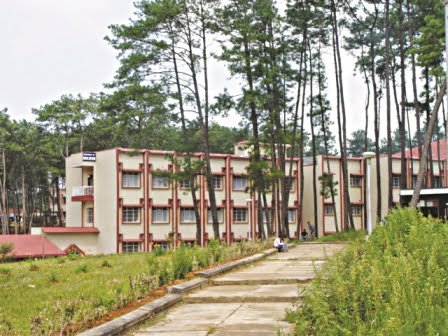
The chip, designed as a technology-driven and eco-friendly solution, has been developed entirely at NEHU’s Department of Electronics and Communication Engineering through the collaborative research efforts of Pankaj Sarkar, Sushanta Kabir Dutta, Sangeeta Das, and Bhaiswajyoti Lahon.
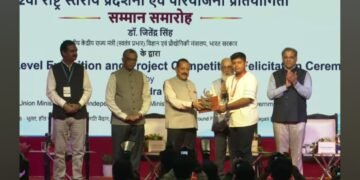
The indigenous chip was formally handed over on November 28 by the Union Minister for Electronics and Information Technology.
While the conceptualization, design and development were carried out at NEHU, the fabrication of the chip was undertaken at the Semiconductor Laboratory (SCL), Mohali, a premier central government facility for semiconductor manufacturing.
RMS is known to cause severe yield losses and deterioration in tea quality, posing a major challenge to the tea industry. The newly developed chip is expected to reduce dependence on chemical pesticides, offering a sustainable and environmentally friendly alternative that benefits tea growers and promotes ecological balance, a press release said today.