












Shillong, Nov 23: Meghalaya High Court judge Justice HS Thangkhiew said that while technology has become an integral part of daily life it has also created new challenges, especially when trying to be safe.
He noted that modern crimes no longer require physical presence, are often transnational, involve victims across jurisdictions and lack traditional forms of evidence, such as eyewitnesses.
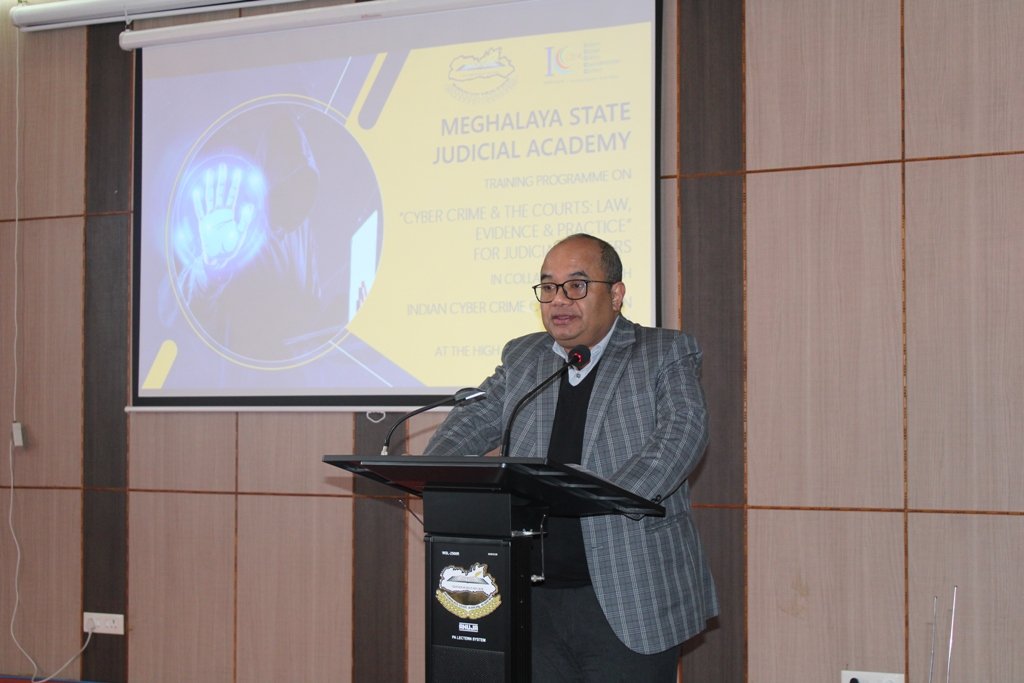
Justice Thangkhiew was addressing at the inauguration of a training programme on “cybercrime & the court: law, evidence & practice” organized by the Meghalaya State Judicial Academy (MSJA) in collaboration with the Indian Cyber Crime Coordination Centre (I4C) under the Ministry of Home Affairs, for judicial officers of the Meghalaya High Court on Saturday
The conventional tools used by law-enforcement agencies and courts, he said, have become inadequate in dealing with these evolving threats.
Justice Thangkhiew highlighted that amendments in the Indian criminal justice system, including the replacement of the Indian Penal Code, CrPC and Evidence Act with three new laws, were aimed at addressing issues of jurisdiction, offences and electronic evidence.
Sharing recent examples, Justice Thangkhiew pointed out that cybercrime cases are rising even in Shillong. He recounted a case involving a lawyer who was duped into transferring Rs 90,000 after receiving an AI-generated voice call mimicking her senior.
The fraudulent transaction, validated through an OTP, was later traced through multiple numbers linked to Bihar and Haryana, leading to the arrest of a man whose SIM card had been misused.
“He was just a pawn and had no idea his number was being used,” he noted.
Justice Thangkhiew also stressed that cybercrime investigations often require coordination among several agencies, particularly when bank accounts are frozen to prevent fund movement. In some cases, he said, innocent individuals suffer when their accounts are incorrectly frozen, disrupting their livelihoods.
He expressed hope that the training programme would enable judicial officers to better understand emerging cybercrime trends, electronic data preservation and the evolving role of courts in handling such cases.
He thanked the resource person for providing valuable insights into strengthening the justice system’s response to technology-enabled offences.
During the programme, a series of technical sessions were conducted. Nisheeth Dixit, Advocate and Cyber Law Consultant with the Rajasthan High Court, delivered a session on “Cybercrime and Cyber Laws” supported by detailed case studies.
Deepak Kumar, Senior Cyber Intelligence and Forensics Expert at I4C, Ministry of Home Affairs, presented an overview of the I4C framework, its services, latest trends and key achievements.
The day also featured another session by Nisheeth Dixit on the appreciation, admissibility and handling of electronic evidence, supplemented with relevant case laws.