











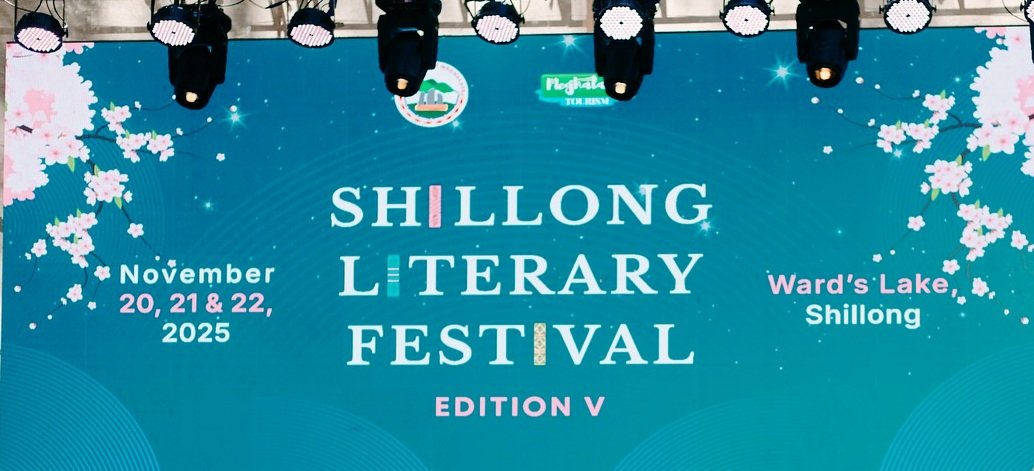
Shillong, Nov 23: The fifth edition of the Shillong Literary Festival concluded on Saturday at Ward’s Lake, bringing to a close three days of literary conversations, performances and creative exchange.
Growing bigger and bigger with every passing edition, this year highlighted Shillong’s unique ability to inspire, echoing the words of noted writer Banu Mushtaq, who said, “To stand in Shillong today feels like walking into a page that has been quietly waiting for me.”
The festival witnessed an impressive turnout, with visitors engaging across multiple sessions that sparked meaningful dialogue and reflection. Over three days, audiences were treated to an extraordinary spectrum of themes spanning literature, cinema, history, oral traditions, geopolitics, poetry, folklore and music.
The opening session of the final day, titled “Our Hills, Our Histories,” saw Madeline Y. Tham and Daniel Ebor Challam in conversation with David R. Syiemlieh, exploring narratives of land, memory, and the interconnected fabric of local histories.
This was followed by an insightful panel on “Cinema, Literature and the Impact of Social Media,” featuring Merlvin Jude Mukhim, Ailynti Nongbri, and Lucetta J. Syiem, who examined the evolving links between film, contemporary storytelling, and digital culture. While tracing the growth of Khasi literature and the early challenges of Khasi cinema, the panel highlighted the increasing role of social media in shaping youth perspectives and emphasised responsible digital engagement.
In a session devoted to literature, “The Power of a Poem,” former minister Paul Lyngdoh, along with Lalnunsanga Ralte and Dorothy Marak, presented and translated poetry that reflected the region’s linguistic diversity. Lyngdoh quoted Pablo Neruda’s line, “If you ask me what my poetry is, I must tell you I don’t know; but if you ask my poetry, it will tell you who I am,” before sharing works such as “Invisible Time” and “In the Graveyard of My Heart.”
A special session titled “The Hills Are Alive with the Shillong Choir’s Music” brought together William Richmond Basaiawmoit, Jessica S. Lyngdoh, Rishila M. Jamir, and Riewbankit Lyndem, moderated by Sir Brian Wallang, offering audiences an intimate look at the Shillong Chamber Choir’s remarkable artistic journey.
In “Whose History Is It Anyway?” authors Mmhonlumo Kikon and Sanjeeb Kakoty, in conversation with Glenn C. Kharkongor, explored the importance of viewing history through local perspectives and re-telling historical narratives.
The panel “South Asian Literature in World Literature” with Shehan Karunatilaka, Jerry Pinto, and Kanishka Gupta in conversation with Seema Sharma highlighted how South Asian writing continues to break past traditional gatekeeping, proving that genuine stories always find readers despite the limitations of awards and recognition.
Author Keshava Guha reflected on his novel in “The Tiger’s Share,” in conversation with Narayani Basu, discussing themes of responsibility, inheritance, and entitlement in contemporary India.
Railways took centre stage in “Railsong,” where Rahul Bhattacharya spoke with Preeti Gill about his new novel. He described the railways as a “human network,” connecting people, cultures, and stories while transforming travellers along the way.
In “In the Footsteps of Giants,” Jamling Norgay and Priyambada Jayakumar, in conversation with Glenn C. Kharkongor, reflected on the legacies of Tenzing Norgay and M.S. Swaminathan. Priyambada spoke about Swaminathan’s humility and lifelong dedication to farmers, while Jamling shared personal memories of his father and insights into Sherpa culture.
During “Songs of Our People,” photographer Anurag Banerjee unveiled the second book of his visual anthology in a conversation with Janice Pariat, chronicling Meghalaya’s dynamic music scene and reflecting on his personal bond with Shillong.
The final literary conversation, “Through the Device Darkly,” featured Jerry Pinto, Prayag Akbar, and Ankush Saikia in discussion with Karishma Upadhyay on the relationship between the screen and the page in the age of OTT adaptations.
The festival concluded with captivating performances under the Meghalaya Grassroots Music Project, bringing audiences together in celebration of Meghalaya’s musical heritage against the serene backdrop of Ward’s Lake.