






Shillong, Oct 22: The Khasi Hills Autonomous District Council (KHADC) has passed an official resolution to urge the Centre to exclude tribal areas from the Office Memorandum (OM) issued by the Union Environment and Forest Ministry exempting mining projects involving atomic minerals like uranium from public consultations.
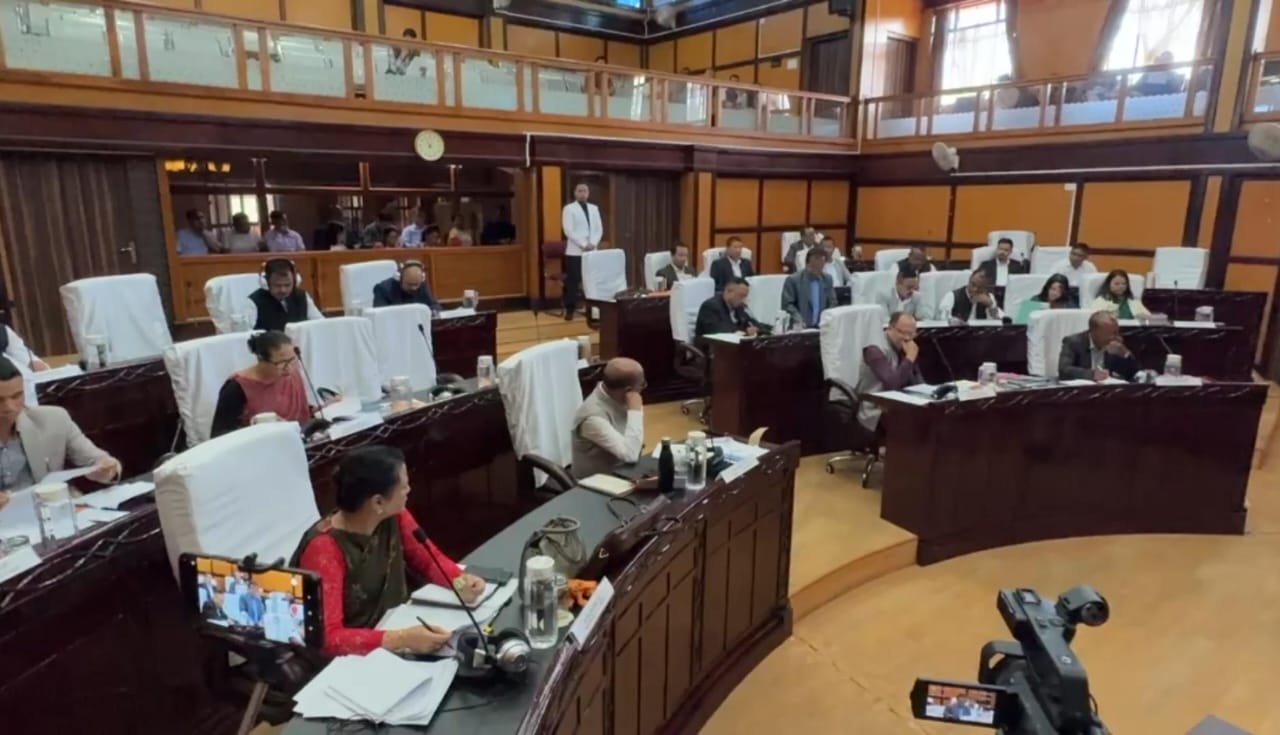
KHADC Chief Executive Member (CEM) Winston Tony Lyngdoh tabled the resolution during the first day of the Winter Session of the district council today.
“Therefore, this House hereby resolves to urge upon the concerned Ministry of Environment, Forest and Climate Change and the Government of India to exclude the application of the aforesaid Office Memorandum dated 8th September 2025, within the Tribal Areas of the Khasi Hills District,” the resolution reads.
The CEM said the OM would deprive indigenous people of their rights to express opposition and would encourage land grabbing and destroy the environment.
“Whereas, the said memorandum is perceived as an infringement on the age-old customs and traditions of the indigenous tribal communities and viewed as an encroachment upon our ancestral homeland to exploit our land and resources without our consent, thereby exposing our people and environment to grave health and ecological hazards,” the CEM said.
Lyngdoh said as per the OM, all mining projects of atomic minerals notified in Part B and critical and strategic minerals notified in Part D of the First Schedule of Mines and Minerals (Development and Regulation) Amendment Act, 2023, shall be exempted from Public Consultation under sub-clause (f) of Clause 7(III) (i) of EIA Notification Dated 14.8.2006 to facilitate the early operationalization of mining projects with respect to Atomic Minerals, and Critical and Strategic Minerals.
Lyngdoh informed that the KHADC had written to the Secretary of the Ministry demanding exemption from the OM for land under its jurisdiction.
Opposition Leader Titosstarwell Chyne said the OM would have far-reaching consequences for the state, effectively silencing the voice of the indigenous people by doing away with public hearings.
He said the Executive Committee should demand the complete withdrawal of the OM, rather than just seeking exclusion of areas under the jurisdiction of the KHADC.
“If the EC only demands exclusion, it would imply that uranium mining is allowed in other areas, such as Jaintia or Garo Hills. This memorandum will affect the entire state. The resolution is not strong enough. Therefore, I suggest we demand withdrawal of the OM,” Chyne said.
He said the centre has reputedly attempted to mine uranium in the state despite stiff opposition from the people.
The Council’s resolution will now be forwarded to the state government and the Ministry, potentially leading to further negotiations between local and central authorities.
It may be mentioned that uranium mining is a touchy subject in the state where the people in the uranium rich areas of West and East Khasi Hills bordering Bangladesh have been resisting all attempts by the Government of India to mine the atomic mineral. The anti-mining campaigns have hinged largely on the mandatory public hearings during which the public have said “No to mining”, emphatically over the years.