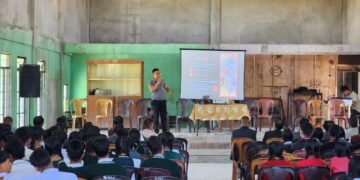









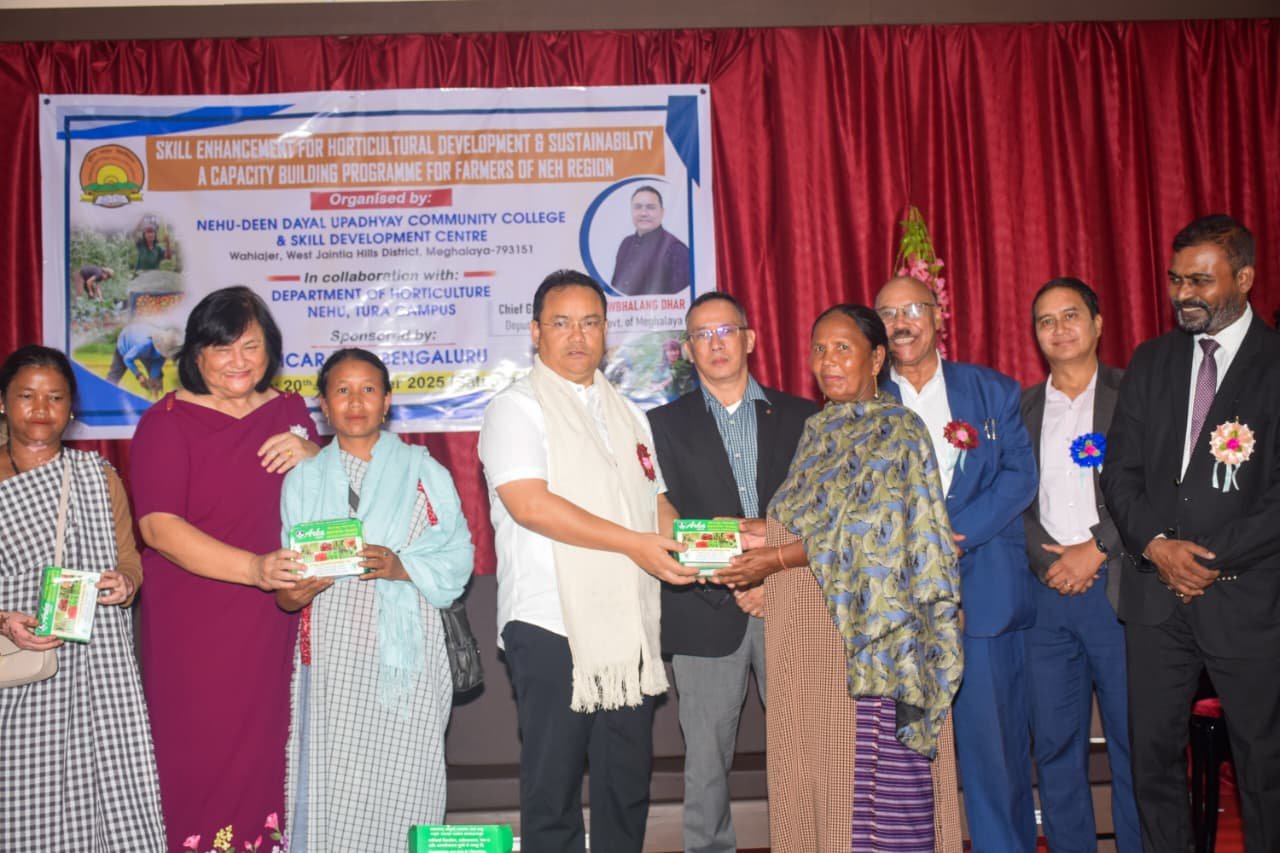
Shillong, Sep 21: The Pt Deen Dayal Upadhyay Community and Skill Development Center (DDUCC), Wahiajer, a constituent college of North-Eastern Hill University (NEHU), organised a capacity building programme for farmers of Jaintia Hills entitled ‘Skill Enhancement for Horticultural Development’ on Saturday.
The programme was conducted in collaboration with the Department of Horticulture, NEHU Tura, with horticultural inputs sponsored by ICAR–IIHR Bengaluru.
The event witnessed the participation of nearly 250 attendees, including farmers, students, staff, invitees and dignitaries from across the region.
The first technical session was led by experts Prof CP Suresh, Department of Horticulture, NEHU Tura Campus & Nodal Officer of the Capacity Building Programme, and Risakaru Lyngdoh, Subject Matter Specialist in Agronomy, KVK Wahiajer. Through interactive sessions, participants gained practical insights into modern horticultural practices with a special emphasis on cultivating nutrient-rich crops to promote health and wellness among the youth and women, aligning with the National Nutrition Week 2025 theme: ‘Eat Right for a Better Life’.
Present at the programme was Deputy Chief Minister Sniawbhalang Dhar, Prof S Umdor, Pro-Vice-Chancellor of NEHU Shillong, Prof SK Dixit, Registrar in-charge of NEHU, FR Sumer, Principal in-charge of DDUCC, and other dignitaries, faculty and community members.
Addressing the gathering, Dhar encouraged farmers to actively participate in such programmes to build entrepreneurial capacities for sustainable livelihoods and assured government support in providing the necessary infrastructure for the growth of DDUCC.
Umdor highlighted the vital role of horticultural farming in ensuring food security, employment generation, and rural development. He urged participants to apply the knowledge gained and to explore government schemes and subsidies to expand their farming practices.
The programme concluded with the distribution of horticultural inputs and seedlings sponsored by ICAR-IIHR Bengaluru, to the participants, most of whom were women farmers.